
Rhodes is larger than most visitors realise. These five drives reach corners of the island where the bus tours do not go.
Lindos is the most photographed corner of Rhodes, but the island stretches almost ninety kilometres from north to south and the interior is largely empty. A rental car opens up the parts of Rhodes that the day-tour buses do not. Five trips, each a comfortable day out from Lindos, give a fair sense of what the island actually contains.
Rhodes Old Town, north. Fifty kilometres up the east coast, an hour’s drive. The medieval city has been UNESCO-listed since 1988 and remains the largest inhabited fortified town in Europe. Park outside the walls and enter on foot through the Marine Gate. The Street of the Knights — six hundred metres of cobbled lane lined with the inns of the various national tongues of the Order of Saint John — runs uphill to the Palace of the Grand Master, rebuilt by the Italians in the 1930s on Knights’ foundations. Visit early or in the evening; midday is for the cruise crowds.
Tsambika and the eastern beaches, north. Twenty-four kilometres north of Lindos, about twenty-five minutes by car. The Monastery of Panagia Tsambika sits on a headland 300 metres above the sea; a flight of 350 steps leads up from the road. The view from the top runs from Lindos to Faliraki. Beneath the monastery is one of the longest sand beaches on the island, a kilometre of fine golden sand and gentle water, far less crowded than the resorts further north.
Prasonisi, south. The southern tip of Rhodes, 45 kilometres from Lindos, about an hour. Here the Aegean meets the Mediterranean across a thin sand isthmus that links the main island to a small rocky islet crowned by a lighthouse built in 1890. The west side of the isthmus is one of the best windsurfing and kitesurfing spots in Europe; the east side, sheltered by the islet, is glassy and warm. In the high summer the isthmus disappears under water and you can wade across at thigh depth.
Embonas and the wine country, west. Eighty kilometres west across the island, about an hour and a half through pine forest on the slopes of Mount Attavyros. Embonas is the highest village on Rhodes, the only one inside the wine appellation, and the centre of the island’s small wine industry. The white grape is Athiri, light and mineral; the red is Mandilaria, structured and dry. Two or three small wineries open their cellars for tastings — Emery and Alexandris are the easiest to find. Lunch at one of the village tavernas; the lamb here is reared on the mountain.
Monolithos and Kritinia castle, west-south. Ninety kilometres from Lindos, the longest of these drives at around an hour and three-quarters, and the most rewarding for those who enjoy roads with no traffic. The castle of Monolithos perches on a rock pinnacle 240 metres above the sea, built by the Knights in the fifteenth century. Further north, the Kritinia castle has a Venetian-style coat of arms above the gate. The road between them traces the empty west coast through Siana, where the local distillate is souma, a clear spirit of crushed figs.
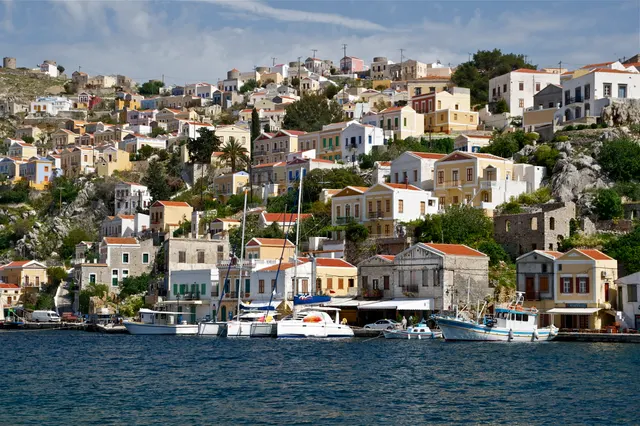
There is a sixth option that does not involve a car at all. Symi is a 90-minute ferry from Rhodes harbour, leaving at eight in the morning and returning around five. It is technically not a day trip from Lindos — you must drive into Rhodes Town to catch the boat, then come back the same way — but it is worth the logistical effort. We have written about Symi separately.
A practical note on the driving. Rhodes roads are well surfaced but narrow, and goats genuinely do appear without warning. Diesel is roughly fifteen percent cheaper than petrol. The island is small enough that you can fit two of these trips into one day if you start early, but it rewards the slower rhythm of one trip per day. Leave Lindos by nine. Be back by seven for the rooftop.