
Most visitors climb the Acropolis in an hour. Knowing what you are looking at — and at what age — makes the same climb a different walk.
The Acropolis of Lindos is the second most visited archaeological site in Greece after the Athenian one. Most guests walk up it in under an hour, take three photographs and walk back down. The site rewards a closer reading. What you are looking at is not one monument but four — Mycenaean, Classical Greek, Hellenistic, Byzantine, and Knights’ — stacked on top of each other on a single rocky headland 116 metres above the sea.
The earliest evidence of occupation on the rock dates to around 2000 BC, when a small Mycenaean settlement existed on the upper terrace. Sherds of late Bronze Age pottery have been recovered from the rock fissures. The site’s function from the beginning was religious; a sanctuary to a mother goddess existed here before the cult of Athena was overlaid on it some time in the eighth or seventh century BC. The historian Herodotus, writing in the fifth century BC, says that the daughters of Danaos founded the temple of Athena Lindia after fleeing from Egypt. Whatever the literal truth of that, the place was already old when the Greek-language sources started to write about it.
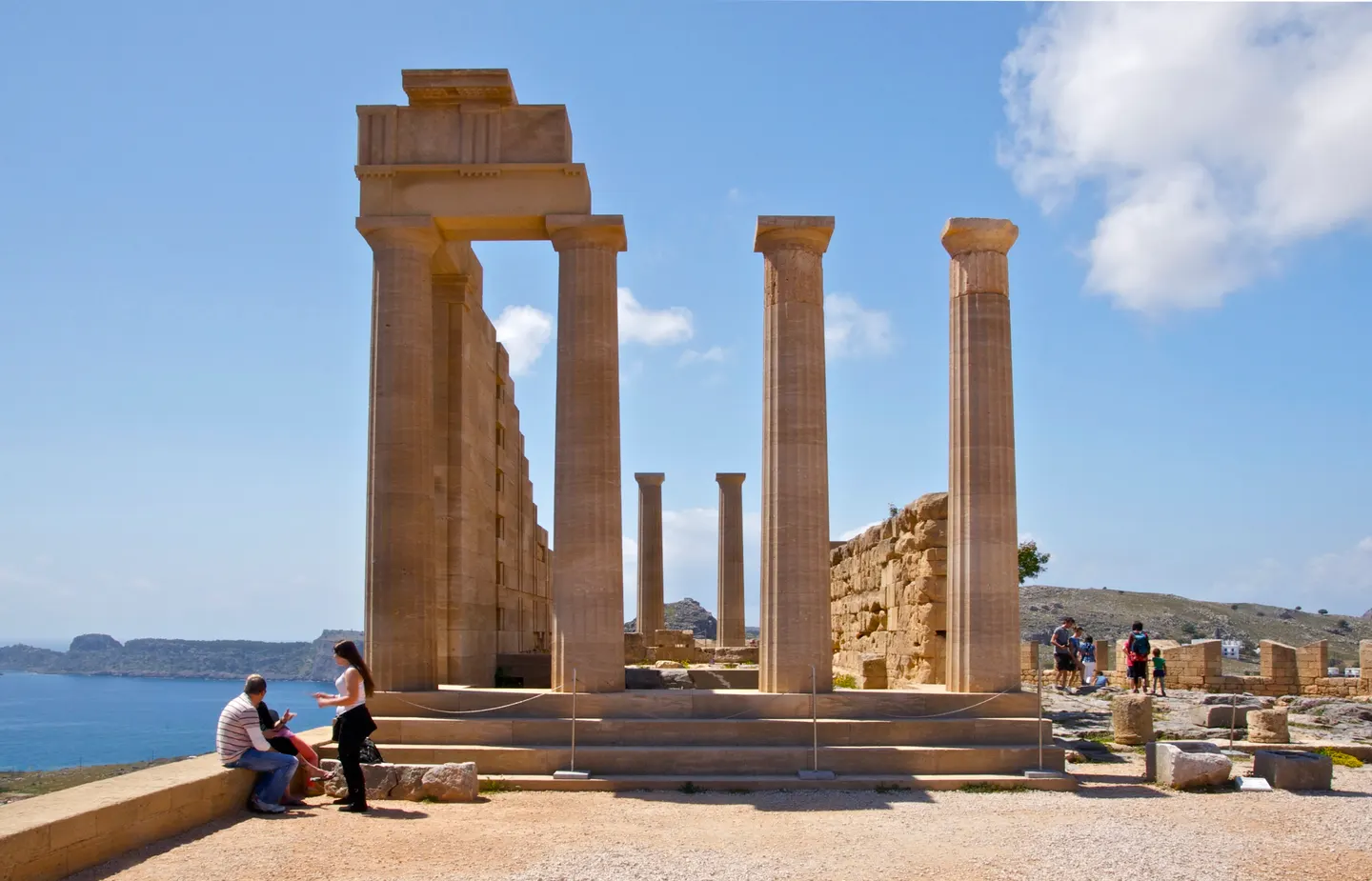
The Doric temple of Athena Lindia that stands today was built around 300 BC, in the late fourth century, replacing an earlier sixth-century BC temple destroyed by fire. It is a small temple — only thirteen by eight metres on the platform — and it is not pretending to be the Parthenon. What it has instead is one of the great theatrical settings of the ancient world. The temple stands at the southern edge of the rock with the sea directly below, and ancient pilgrims approached it up a monumental staircase from the north, passing through a colonnaded portico called the propylaea.
Carved into the rock at the foot of the propylaea steps is a Hellenistic relief of the prow of a trireme, dating from about 180 BC. It is sometimes called the Lindian Ship. The relief was the base for a statue of an admiral, Hagesander, son of Mikion, who had won a sea battle for the island; the statue is gone but the ship remains. The carving is detailed enough that you can count the oar-ports on the upper register. It is the single object on the rock that I send guests to look at first.
After the Hellenistic period the rock changes hands repeatedly. The Romans absorbed Rhodes in 164 BC and used the sanctuary; the early Byzantines built a small church of Saint John on the temple platform in the fifth or sixth century AD, of which only foundations remain. The site’s most visible later phase belongs to the Knights Hospitaller, the military-religious order that ruled Rhodes from 1306 to 1522 after they were expelled from the Holy Land. The Knights fortified the rock as a coastal lookout, extending and rebuilding the walls during the fourteenth and fifteenth centuries. The thick lower walls you walk through to enter the site are theirs.
Inside the Knights’ walls is the small two-storey Governor’s building, also fourteenth century, with vaulted rooms that once held the garrison stores. Climb to the upper level for the view across the Hellenistic stoa, an L-shaped colonnade of which several columns have been restored. Beyond the stoa, the monumental staircase rises to the temple platform; this is the same staircase the ancient pilgrims used, much of it original.
The site passed from the Knights to the Ottomans in 1522 after a six-month siege of Rhodes Town. The Ottomans used the rock as a watchpost but did not build on it significantly. The Italians, who took the Dodecanese in 1912, began the first systematic excavations and restored several columns of the stoa using anastylosis — the technique of reassembling fallen ancient blocks in their original positions, supplementing only where strictly necessary. The Acropolis joined the UNESCO World Heritage list in 1988, together with the medieval town of Rhodes.
Practical notes. The site is open from eight in the morning, with last entry at three thirty in winter and seven in summer. Tickets are bought at the village edge or online; the climb from the village square takes fifteen minutes at a reasonable pace, longer in the heat. Bring water and a hat. The best light is the first hour after opening and the last hour before closing; midday is hot, crowded and flat. From Lindos Comfy Suites the gate is a twelve-minute walk uphill.
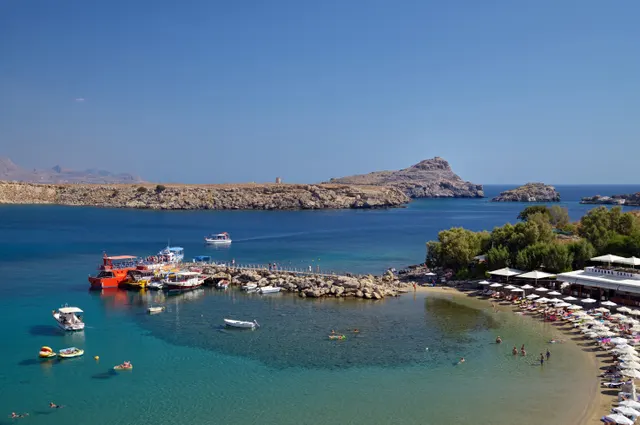
What the Acropolis offers, beyond the temple itself, is a kind of perspective. From the top you can see the Knights’ castle of Pefkos to the south, the medieval village of Lindos in the bowl below, and the empty Aegean to the east. Three thousand years of continuous occupation are visible in a single glance. That is, in the end, why people come up.