
The Greek breakfast is not a buffet. It is a small, deliberate meal built from a few perfect ingredients, and it sets the tone for the whole day.
There is a particular kind of hotel breakfast that has spread across the Mediterranean and erased almost every regional difference. It involves chafing dishes of scrambled eggs, industrial pastries, a juice machine, and a coffee station. It is competent and forgettable. It is also nothing to do with how Greeks actually eat in the morning.
The real Greek breakfast is small. It almost always begins with thick strained yogurt — sheep’s milk where you can find it, drained for hours until the spoon stands up in the bowl. A spoonful of honey goes on top. In the Dodecanese the honey is most often thyme honey, produced in the dry hills above villages like Lardos and Apollona, where wild thyme flowers in the late spring and the bees do the rest. The taste is herbal, almost peppery, and entirely unlike supermarket honey.
Then a hand-rolled pie. Tyropita, with feta and a touch of mizithra. Spanakopita with spinach and dill. Bourekia stuffed with sweet pumpkin. The fyllo is made the night before, rolled thin on a wooden table dusted with corn flour, layered with olive oil rather than butter. It crackles when you press it.
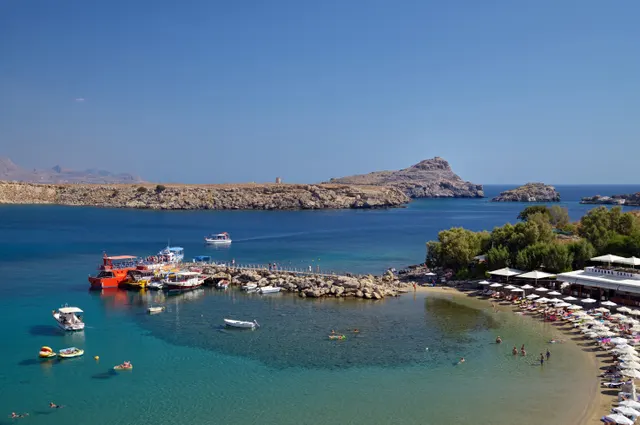
The fruit on the table tells you where you are. In Rhodes that means oranges from Massari in spring, figs from Archangelos in late summer, watermelon from Apolakkia in August. Hand-squeezed juice is poured into a small glass — never the bottomless American carafe. Coffee is either Greek (in a small briki, twice-boiled, with the foam carefully spooned on top) or a freddo espresso, the iced shaken version that has become a national obsession since the early 1990s.
What is missing from this table is just as important as what is on it. No bacon. No sausages. No piles of pastries. No competition. The Greek breakfast does not announce itself; it lets the ingredients speak. The yogurt is the yogurt of one farm. The honey is the honey of one season. The eggs, if they come, are boiled and served whole.
At Lindos Comfy Suites the breakfast follows this tradition closely. We work with three small producers on the island — a beekeeper in Lardos, a yogurt-maker near Afandou, and an olive farm at Kalathos that presses oil from Koroneiki and Maronia varieties. The bread is delivered each morning from the bakery in Pylonas. None of this is marketed. It is simply what breakfast looks like when no one has tried to make it more impressive than it needs to be.
The slow Greek breakfast also sets a pace. You are not standing at a buffet calculating value for money. You are sitting at a small table in the shade, with the morning ahead of you, eating a few good things one after another. Conversations get longer. Plans get vaguer. By the time the second coffee arrives you have lost any interest in rushing to the Acropolis, which is the correct frame of mind for visiting it anyway.
There is, in the end, a small philosophical claim built into this kind of breakfast. It is that a meal is the sum of its ingredients, not the length of its menu, and that hospitality is what happens when a host has chosen carefully on your behalf rather than offering you everything at once. The Greek breakfast has been doing this for several thousand years. Most days the buffet still loses.
Two small additions for visitors who want to extend the table at home. The thyme honey we serve is from Sklavenitis, a beekeeper above Lardos who has roughly two hundred hives and sells from his door for half what the airport gift shops charge. The yogurt is from a co-operative near Afandou; it is not exported and you will not find it on any supermarket shelf outside Rhodes. We can arrange the introduction. The point of the slow breakfast is, in part, that the supply chain stays short.